Redesign the Work First, Then Deploy the Tools: Why Most Organisations Have the Sequence Backwards


Organisations that redesign their workflows before deploying AI tools consistently outperform those that reverse the sequence. Deploying AI onto an existing workflow adds a tool to a broken process. Redesigning the workflow first — mapping how work should flow, then selecting tools to run that redesigned process — is what produces efficiency rather than additional complexity.
There is a sequencing error at the root of most enterprise AI programmes that underperform. It is not a technology error. It is not a training error. It is a sequencing error.
Most organisations deploy AI tools first — roll out the platform, grant access, train the team — and then try to redesign work to fit around the technology. The result is predictable: AI gets used for individual tasks but never becomes embedded in the processes that actually drive organisational performance.
Randstad’s 2026 CHRO roundtable found that the most effective enterprise AI leaders are converging on a different approach: redesign the work first, then deploy the tools to run the redesigned process. i4cp’s 2026 CHRO Priorities research confirms that 50% of CHROs now prioritise strategic workforce planning and work redesign as a direct response to AI — before tool selection, not after.
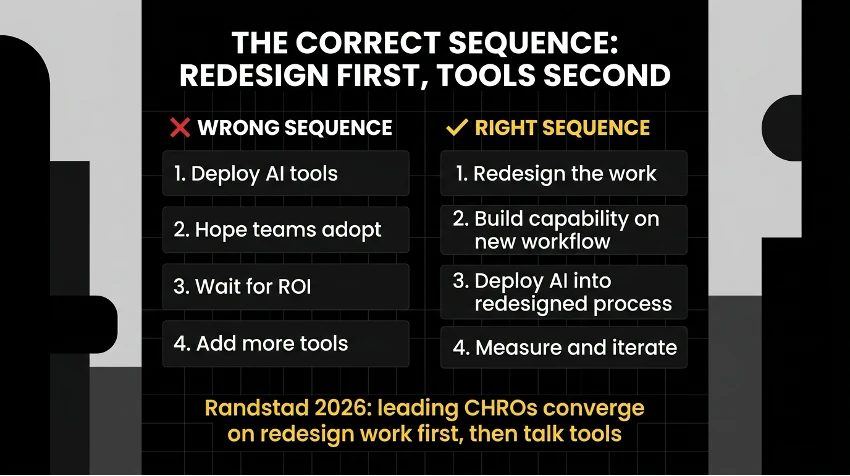
The tools used in an AI programme matter far less than the order in which they are introduced. AI deployed onto an existing workflow inherits that workflow's existing inefficiencies and friction points. The tool becomes one more layer to manage rather than a structural improvement. Sequencing correctly — redesign first, deploy second — is what separates programmes that generate efficiency from those that generate more complexity.
This is the bolt-on problem. The WEF’s 2026 research on AI at work documented the pattern: deploying AI without aligning it to workflows ends up increasing coordination burden rather than reducing it. The tools work. The process didn’t change to use them. So the organisation gets the cost of both the old process and the new technology without the benefit of either fully.
Organisations that redesign the work first then deploy tools to run the redesigned process produce a different outcome. The AI is not bolted on — it is structural. It is the mechanism that makes the new process possible, not an addition to the existing one.
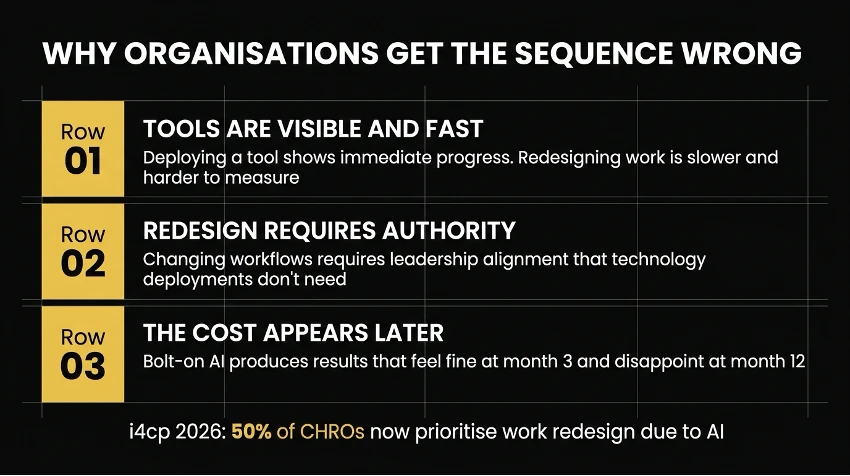
Vendors sell tools, not workflow redesign. Procurement processes are built for technology purchasing. Boards want to see AI investment activated quickly. All of these forces push organisations toward deployment first. The less visible, harder-to-procure work of mapping and redesigning workflows gets deferred — and the AI programme inherits the consequence.
AI platforms are sold on access and features. Procurement processes evaluate tools. By the time an organisation has selected, contracted, and rolled out a platform, there is natural pressure to justify the investment through deployment metrics — users onboarded, licences activated, training completed. Work redesign is slower and harder to measure. It gets deprioritised.
Deploying a tool is fast and visible. Redesigning a workflow is slow and invisible until it is done. Leadership timelines favour visible progress. The organisation that deploys a tool in month two looks further ahead than the one that is still mapping its workflows. The results at month twelve tell a different story.
Most organisations have technology teams capable of deploying AI platforms. Far fewer have the capability to systematically redesign workflows around AI capabilities before deployment. The path of least resistance follows the existing capability.
Work redesign before deployment means three things in sequence: mapping the current workflow in enough detail to identify where friction occurs, designing the improved version of that workflow with AI as a component, and only then selecting tools to execute it. The selection question changes from "which AI tool shall we roll out?" to "which tool best runs the workflow we have already designed?"
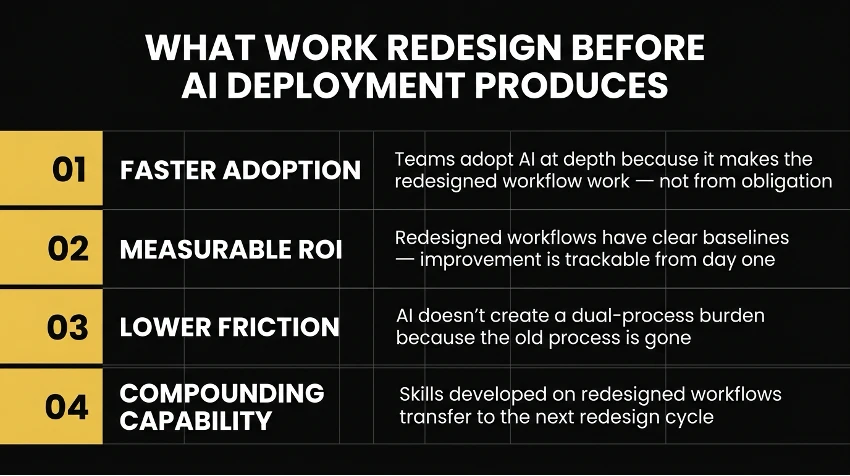
Before any AI tool is selected or deployed, map the steps of the workflow as it actually runs — not the official process document, but the actual sequence of tasks, handoffs, decision points, and time sinks. This map reveals where AI can remove steps, compress timelines, or change the nature of a task. It also reveals where AI will add friction if deployed naively.
Not every step in a workflow should change. Work redesign for AI involves identifying the specific steps where AI changes the nature of the work — where a task is absorbed, where a handoff is eliminated, where quality improves, where a decision can be made with better information. These are the redesign points. Everything else stays the same.
Once the redesign points are identified, design the new workflow sequence — what the process looks like when AI is doing what AI does well. Only then evaluate which AI tools are best suited to run the redesigned process. Tool selection follows process design. This is the reversal of the typical sequence.
AI training delivered before work redesign teaches people how to use tools in isolation. Training delivered after work redesign teaches people how to run the new process. This is what embedding AI in redesigned team workflows actually means — the second produces behaviour change; the first produces awareness.
→ Work with Humaine to redesign your team’s workflows before your next AI tool rollout
Because the sequence determines the outcome. AI deployed into an unredesigned workflow becomes an add-on — teams manage both the old process and the new tool, generating more coordination burden rather than less. AI built into a redesigned workflow is structural — it makes the new process possible and produces measurable efficiency gains from the start.
Four steps: mapping the current workflow as it actually runs (not the official process document), identifying the specific steps where AI changes the nature of the work, designing the new process sequence before selecting tools, and building team capability for the new process rather than the old one.
Three forces push the tool-first sequence: vendor procurement cycles that create pressure to activate licences quickly, leadership preference for visible progress (tool deployment) over invisible design (workflow mapping), and capability asymmetry (most organisations have technology teams but few have work redesign capability).
Randstad’s 2026 CHRO roundtable found that the most effective enterprise AI leaders are converging on redesign-first as the winning approach. i4cp’s 2026 CHRO Priorities research found that 50% of CHROs now prioritise strategic workforce planning and work redesign as a direct response to AI. WEF’s 2026 research documented the bolt-on problem: AI deployed without workflow alignment increases coordination burden rather than reducing it.
Most enterprise AI programmes are failing not because the tools are wrong but because the sequence is wrong. Deploying before redesigning produces bolt-on AI — tools sitting alongside unchanged processes, generating cost without proportionate value.
The organisations generating real AI returns have reversed the sequence. They map the work, identify the redesign points, design the new process, and then deploy the tools to run it. Training follows process design rather than preceding it.
The sequence is not a minor operational detail. It is the decision that determines whether the AI investment compounds or disappears.