From Prompts to Processes: What It Actually Takes to Embed AI in How Your Team Works


There is a version of AI adoption that is real but limited: individuals using AI tools for personal tasks.
The account manager who drafts emails faster. The analyst who summarises reports in seconds. The content lead who generates first drafts. Each of these is a genuine improvement — and none of them is what AI adoption looks like when it creates competitive advantage.
The shift from individual AI use to embedded AI processes is the shift that most organisations talk about and very few have actually made. Deloitte’s 2026 State of AI research found that only 30% of organisations are redesigning key processes around AI. IBM’s CIO research describes end-to-end workflow integration as the critical unlock for enterprise AI value.
The gap between where most teams are and where the value actually lives is the gap this blog addresses.
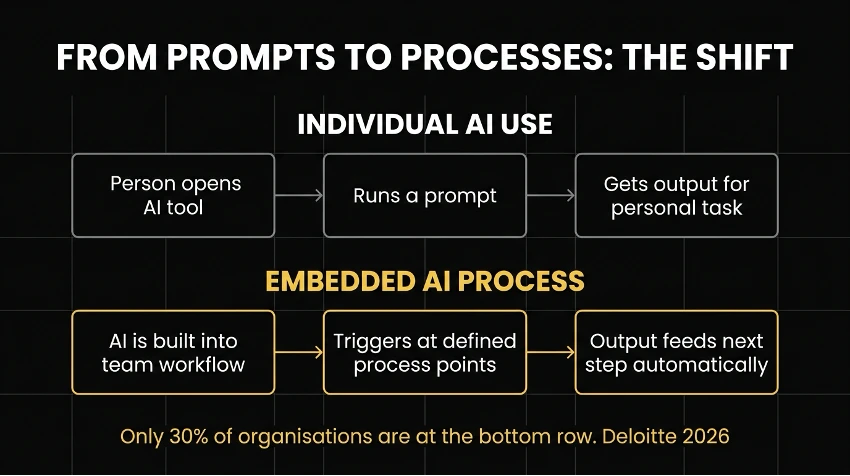
Individual AI use is characterised by a simple pattern: a person opens a tool, runs a prompt, gets an output, and uses it for their own task. The tool is personal. The benefit is personal. The workflow around the person doesn’t change.
This produces real productivity gains. Studies consistently show individual time savings of 20–40% on specific tasks. But these gains are bounded. They apply to the tasks where AI was used, for the individuals who chose to use it, in the moments when they remembered to.
Individual AI use plateaus because it is discretionary. It depends on individual initiative, individual skill, and individual judgment about when AI is appropriate. The moment a team member doesn’t use AI — because they’re busy, uncertain, or working in a part of the process where the habit hasn’t formed — the benefit disappears.
Embedded AI processes don’t depend on discretion. They are part of how the team works — which means the benefit accrues consistently, regardless of individual enthusiasm.
Most teams cycling through AI adoption programmes get stuck at one of three points before they reach genuine workflow embedding.
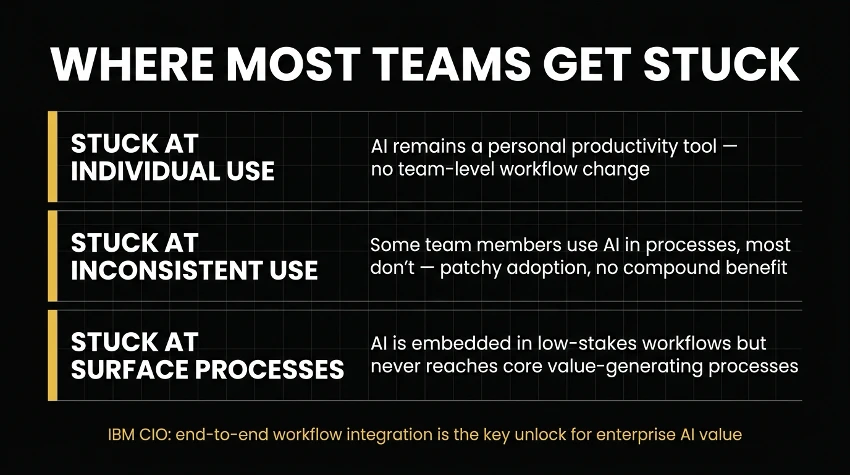
AI remains a personal productivity tool. Some team members use it enthusiastically; others barely at all. There is no team-level process that incorporates AI. The benefit is real but not compounding.
AI has been incorporated into some team processes but not systematically. Certain people use it in the workflow; others don’t. The output is inconsistent — some team members produce AI-assisted work, others produce traditional work, and there’s no standard for what the team’s output should look like.
AI is embedded in workflows, but low-stakes ones: formatting, scheduling, reporting. It never reaches the core value-generating processes where change would compound. Teams are using AI in the periphery and continuing to do the most important work entirely by hand.
Each of these stall points has a specific cause. And each requires a specific intervention — not more encouragement, but structural change to how the work is designed.
Moving from individual AI use to embedded AI processes is a four-step transition — and almost every organisation skips at least two of them.
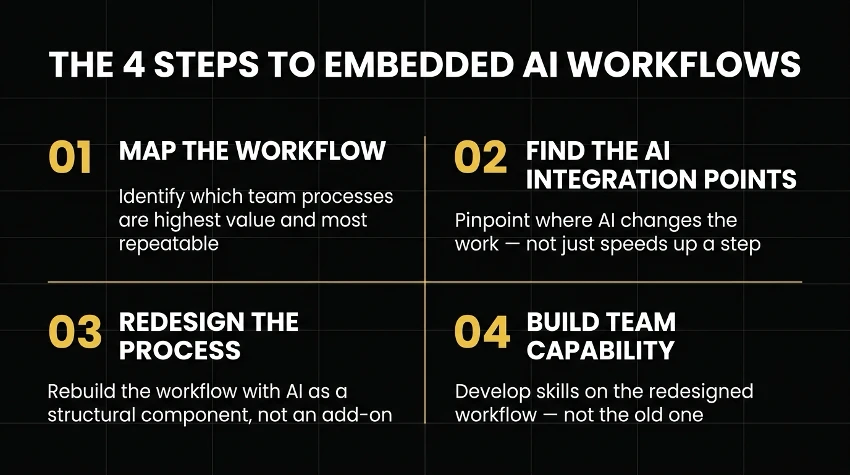
Before AI can be embedded, the team needs a clear map of its core processes — the repeatable, high-value workflows where AI integration would change the output or the speed of production. This step is often skipped because it is assumed to be obvious. It is rarely obvious. Teams have significant variation in how they run processes, and that variation makes it impossible to embed AI consistently without a shared baseline.
Not every step in a workflow benefits equally from AI. The task here is to identify the specific points where AI can change the work — not just speed up a step, but alter the output, reduce a handoff, compress a decision cycle, or eliminate a redundant review. This requires someone who understands both the workflow and AI’s actual capabilities.
Once the integration points are identified, the workflow needs to be rebuilt to incorporate them. This is not adding AI to the existing steps. It is redesigning the process before embedding the tool — what gets eliminated, what changes sequencing, what gets added to capture AI’s output. The redesigned workflow is what teams need to adopt — not the tool.
Training and capability building happen on the new process, not the old one. This is a critical sequencing point that most organisations get backwards: they train people on AI tools, then expect them to figure out how to apply the tools to an unchanged workflow. Training must be connected to workflows rebuilt around AI capability or it doesn’t transfer.
→ LINK TO: ‘What an AI-First Operating Model Actually Looks Like’
→ Talk to Humaine about building embedded AI workflows across your team
Individual AI use is discretionary — a person chooses to use a tool for their own task. Embedded AI processes are structural — AI is built into how the team works at defined points in the workflow. The benefit of embedded AI is consistent and compounding; the benefit of individual AI use is variable and bounded.
Because embedding AI in processes requires workflow redesign — not just tool access. Without a redesigned process to embed AI into, individuals default to using AI on personal tasks. The team-level process remains unchanged, so team-level value never accumulates.
It involves mapping existing team processes, identifying where AI can change the work (not just assist it), rebuilding the process with AI as a structural component, and training the team on the redesigned workflow. Each step is necessary; skipping any of them produces a different version of the same stall.
Measure the process, not the tool. If AI is genuinely embedded, cycle times will have changed, output quality will have shifted, or handoff points will have been eliminated. If none of those have moved, AI is being used in the process but not embedded in it.
The value of AI in enterprise settings is not in the tool. It is in what the tool does to the process.
Individual productivity gains are real but bounded. Embedded AI processes are where the compounding begins — where team output changes, consistency improves, and AI stops being something individuals choose to use and becomes part of how the team works.
Getting there requires four things that most AI programmes skip: process mapping, AI integration point identification, workflow redesign, and capability building on the new process. Each step is necessary. The organisations that do all four are the ones whose AI investment compounds.
→ If your teams are using AI but the work isn’t changing, the process design is the missing step