Why 70% of Enterprise AI Initiatives Fail and Prevention Strategies

Tell us about your team and we'll show you the path forward.
We'll be in touch.
Our team will reach out within 24 hours.

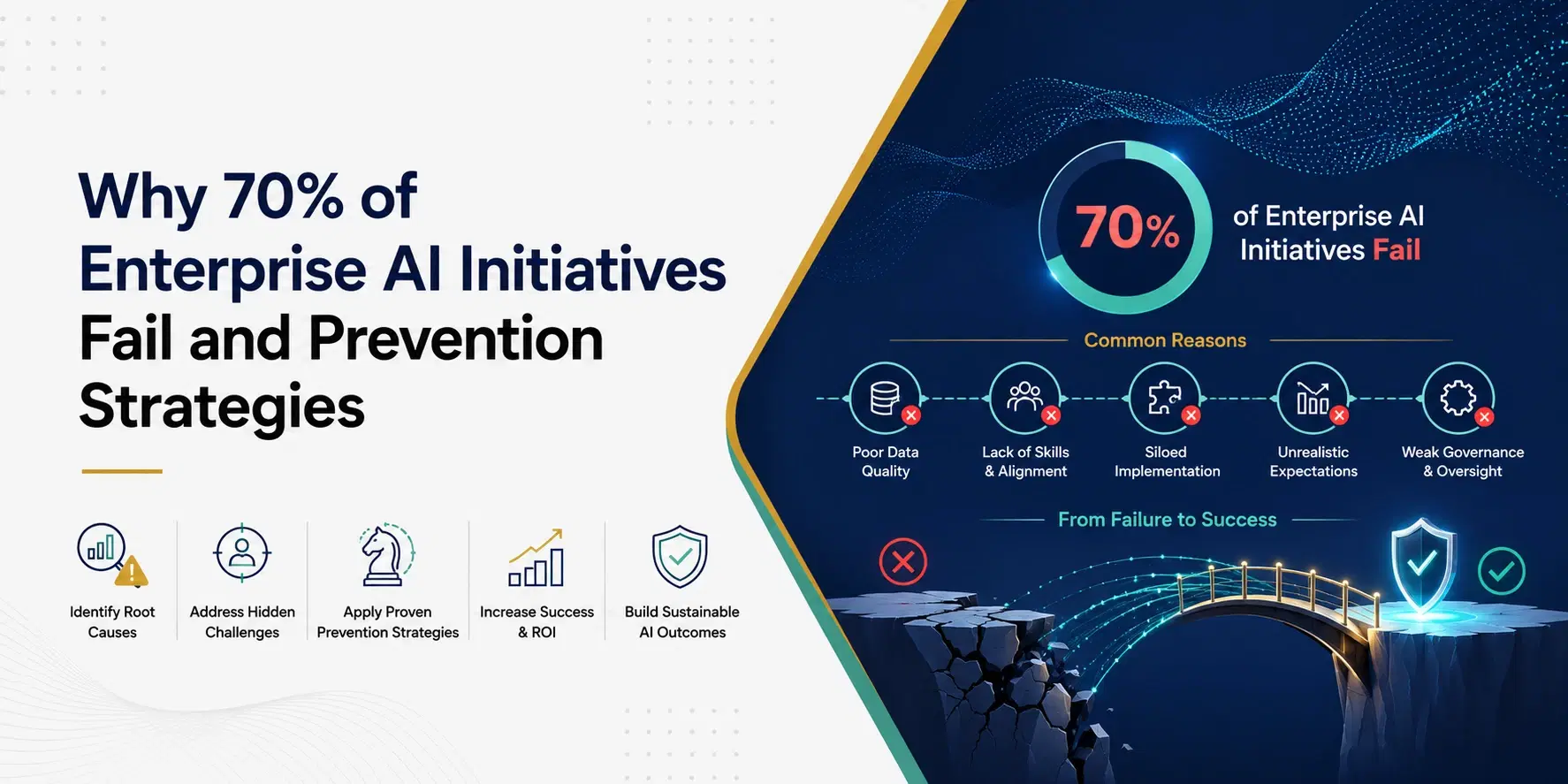
Enterprise AI projects fail at twice the rate of traditional IT initiatives, with 80-95% failing to deliver their intended business value. But the most revealing statistic isn't the failure rate itself—it's that abandonment rates doubled from 17% to 42% between 2024 and 2025, even as AI awareness reached an all-time high of 78% across enterprises. The problem isn't that organizations don't understand AI; it's that awareness has become a substitute for capability, creating a dangerous illusion of progress while the fundamental gap between knowing about AI and using it effectively continues to widen.
TL;DR
Enterprise AI failure rates of 80-95% stem from treating AI as an awareness problem rather than a capability-building challenge, with abandonment rates doubling in 2025 despite record-high AI adoption rates
The primary failure mode occurs after technical success—pilots work in controlled environments but die when organizations lack the internal skills, change management, and role-specific training to scale them enterprise-wide
India's projected 1 million+ AI talent gap by 2027 and similar shortages across Southeast Asia reveal that the capability crisis is structural, not cyclical, requiring systematic internal development rather than external hiring
The 29% of enterprises achieving measurable ROI follow a consistent pattern: leadership alignment first, business-mapped use cases second, function-specific upskilling third, and behavior change measurement throughout
Success requires abandoning generic training approaches in favor of role-based programs that build AI capability within existing workflows, measuring actual behavior change rather than course completion
S&P Global's survey of over 1,000 IT and business leaders across North America and Europe reveals a paradox that explains why AI initiatives are failing faster than ever. Organizations with the highest AI awareness scores—those that had invested most heavily in executive briefings, vendor demonstrations, and innovation workshops—showed the steepest abandonment rates in 2025. MIT's research confirms this counterintuitive finding: 95% of enterprise AI projects fail to deliver measurable returns precisely because awareness activities crowd out capability-building investments.
Consider the typical enterprise AI journey. Leadership attends conferences, watches compelling demos, and returns energized about AI's potential. They fund pilots that succeed technically—the models work, the proof-of-concepts clear every review. Then the projects enter what Stackademic researchers call "the real enterprise" and quietly die. The RAND Corporation's peer-reviewed analysis of 65 industry interviews identifies this as the most common failure pattern: misalignment between AI solutions and actual business problems, not because the technology failed, but because the organization never developed the contextual capability to apply it meaningfully.
The awareness trap is particularly insidious because it feels like progress. Teams complete AI training programs, earn certificates, and check boxes on digital transformation roadmaps. But when they return to their desks—in sales, marketing, finance, supply chain—they have no clear path to integrate what they learned into how they actually work. The result is an organization that can talk about AI fluently but cannot use it effectively.
This dynamic explains why the abandonment rate doubled in a single year. As more organizations reached high awareness levels without building corresponding capability, the gap between expectation and reality became impossible to ignore.
The most dangerous moment in any AI initiative comes after the pilot succeeds. Gartner's data shows that only 30% of AI projects move past this stage, and the failure point is rarely technical. The RAND Corporation's research reveals that AI projects fail at twice the rate of non-AI IT projects specifically because they require organizational capabilities that traditional technology implementations do not.
Take the experience of enterprises attempting to scale AI agents—a use case that should be straightforward given recent advances in large language models. AI in Plain English's analysis of agent implementations found that 73% fail not because the agents don't work, but because teams begin development without defined success metrics tied to actual business processes. The agents perform technically but cannot integrate into existing workflows because no one mapped how the technology should change daily operations.
S&P Global's finding that the average organization scrapped 46% of its AI proof-of-concepts illustrates this scaling cliff in stark terms. These weren't technical failures—the models functioned as designed. They were organizational failures, where enterprises lacked the change management infrastructure, role-specific training programs, and ownership models necessary to absorb new AI capabilities into their operations.
The scaling cliff is particularly treacherous because it appears after apparent success. Technical teams celebrate working prototypes while business stakeholders wait for impact that never materializes. The gap between "it works in the lab" and "it works in the business" becomes a chasm that awareness-focused approaches cannot bridge.
But the scaling cliff reveals something more fundamental about why AI initiatives fail: they require organizations to build new muscles, not just deploy new tools.
Faced with AI capability gaps, most enterprises default to a hiring strategy. But Bain & Company's analysis of India's AI talent market reveals why this approach is structurally doomed. India faces a projected shortage of over 1 million AI professionals by 2027—more than 2.3 million job openings but only 1.2 million qualified candidates to fill them. Southeast Asia shows similar patterns, with 9cv9's research documenting how AI-powered tools are becoming mainstream while skilled practitioners remain scarce across the region.
The talent mirage operates on multiple levels. First, the math simply doesn't work. When every enterprise in a market is competing for the same limited pool of AI professionals, most will lose. Second, even organizations that successfully hire AI talent often find that individual expertise doesn't translate to organizational capability. A few AI champions cannot transform how entire functions—sales, marketing, finance, supply chain—integrate AI into their daily work.
More fundamentally, the external hiring approach misunderstands what type of AI capability enterprises actually need. The Stanford AI Index's finding that 71% of enterprises are still waiting for measurable ROI from their AI investments suggests that the bottleneck isn't advanced technical skills—it's the ability to identify, implement, and scale AI applications within existing business processes. This requires deep domain knowledge combined with AI fluency, a combination that cannot be hired from the outside but must be developed internally.
The enterprises achieving that elusive ROI—the 29% showing measurable returns—share a recognizable pattern. They build AI capability within their existing teams rather than trying to import it. They develop AI fluency in people who already understand the business, rather than hiring AI experts and hoping they learn the business.
This realization points toward a more fundamental question: if hiring won't solve the capability gap, what will?
The enterprises achieving measurable AI ROI follow a strikingly consistent playbook that contradicts conventional wisdom about AI adoption. Rather than starting with technology or hiring specialists, they begin with leadership alignment—ensuring executives have hands-on AI fluency, not just conceptual awareness. They then map AI opportunities to specific business functions before building anything, creating what amounts to a business-first rather than technology-first approach.
But the most critical difference lies in how they approach capability building. Instead of generic AI training programs, successful enterprises deploy function-specific upskilling that teaches sales teams AI applications for sales problems, finance teams AI applications for finance problems, and supply chain teams AI applications for supply chain challenges. This approach directly addresses the core finding from MIT's research: the gap between understanding AI conceptually and using it contextually within actual work flows.
The measurement approach also differs fundamentally. While most enterprises track training completion rates and certification achievements, the successful 29% measure behavior change—are teams actually using AI in their daily workflows? Is output quality improving? Is decision-making speed increasing? This focus on behavioral rather than educational metrics explains why their initiatives survive the scaling cliff that kills most AI projects.
Consider how this plays out in practice. A successful AI adoption program doesn't teach abstract machine learning concepts to marketing teams. Instead, it shows marketing professionals how to use AI for campaign optimization, content generation, and customer segmentation within their existing tools and processes. The learning happens on real work, with real data, producing real business outcomes that can be measured immediately.
This function-specific approach also solves the talent gap problem differently. Rather than competing for scarce AI specialists, organizations develop AI capability within their existing domain experts. The result is teams that understand both the technology and the business context—a combination that external hires rarely possess.
But implementing this approach requires confronting the deepest challenge in enterprise AI adoption: the fundamental mismatch between how organizations think about technology adoption and what AI actually demands.
The doubling of AI abandonment rates in 2025 signals more than implementation challenges—it reveals that enterprises are applying the wrong mental model to AI adoption entirely. Traditional enterprise technology follows a deployment paradigm: install the software, train users on features, measure adoption rates. AI requires a capability paradigm: develop skills, change workflows, measure behavior change. The organizations still using deployment thinking are the ones driving the 42% abandonment rate.
This paradigm shift explains why the most sophisticated enterprises are struggling while some unexpected organizations succeed. Technical sophistication doesn't predict AI success; organizational learning capability does. The RAND Corporation's research confirms that AI project failure rates correlate more strongly with change management maturity than with technical resources or AI budget size.
The capability imperative also reframes the competitive landscape. In traditional technology adoption, first-mover advantage often matters less than execution quality. With AI, the advantage compounds because capability builds on itself. Organizations that develop genuine AI fluency across functions can identify and implement new use cases faster than competitors still stuck in pilot purgatory. The Stanford AI Index's data showing 26-55% productivity gains among successful implementations suggests that this advantage is not marginal—it's transformational.
But perhaps most critically, the capability imperative reveals why the current moment represents a narrow window of opportunity. As AI tools become more powerful and accessible, the differentiator won't be access to technology—it will be organizational ability to absorb and apply that technology effectively. The enterprises building this capability now, while their competitors remain trapped in awareness activities, are positioning themselves for sustained competitive advantage.
The path forward requires abandoning the comfortable fiction that AI adoption is primarily a technology challenge. It's an organizational capability challenge that demands systematic, function-specific, behavior-focused development programs. The 29% of enterprises achieving ROI have already made this transition. The question for everyone else is whether they'll make it before the window closes.
The enterprise AI crisis isn't a technology problem disguised as an organizational challenge—it's an organizational challenge that technology cannot solve. The doubling of abandonment rates despite record-high awareness levels proves that more education, better tools, and bigger budgets won't bridge the capability gap. Only systematic, function-specific programs that build AI fluency within existing workflows can transform awareness into measurable business impact.
The successful 29% of enterprises have already discovered this truth. They've moved beyond pilots and proof-of-concepts to build genuine AI capability across their organizations. As the talent gap widens and competitive pressures intensify, the window for making this transition is narrowing rapidly. The question isn't whether your organization will eventually need AI capability—it's whether you'll build it before your competitors do, or spend the next decade explaining why your pilots never scaled.
S&P Global Market Intelligence, 2025 AI & Data Trends Survey
RAND Corporation, AI Project Failure Research (2025)
MIT Research on Enterprise AI ROI (2025)
Stanford AI Index Report (2026)
Gartner, AI Project Scaling Analysis (2024)
Bain & Company, India AI Talent Gap Report (2025)
AI in Plain English, AI Agent Project Failure Analysis (2026)
Stackademic, Why Enterprise AI Projects Fail: The Missing Digital Anthropology Layer (2025)
9cv9 Research, State of Recruitment in Southeast Asia (2025)
Fullview, 200+ AI Statistics & Trends for 2025