
Why 60% of Companies Are Getting Nothing from AI — And What the Other 40% Do Differently


Most companies are using AI. Most aren’t getting value from it.
Those two facts sitting side by side are the most important thing happening in enterprise leadership right now — and the gap between them is where most AI strategies quietly fail.
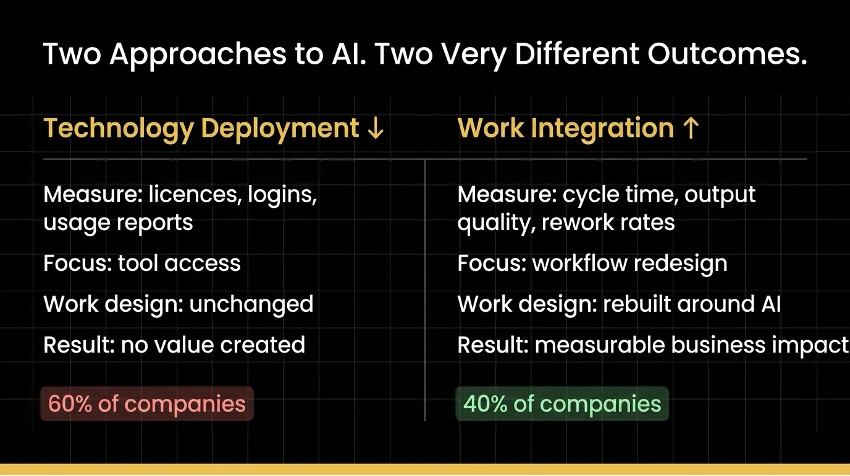
BCG surveyed organisations across industries and found that 60% are generating no material value from AI despite substantial investment. Not marginal returns. No value. Meanwhile, their teams are logging in, using tools, and producing usage reports that look like progress.
Something is clearly broken. And it isn’t the tools.
The instinct when an AI programme underperforms is to reach for a better tool. A different model. A more advanced platform. If the technology were smarter, the thinking goes, results would follow.
BCG’s research points to a different culprit: organisations are focused on technology deployment rather than on how employees integrate AI into their actual work. That distinction — quiet, easy to miss — is the thing separating the 40% generating real value from the 60% that aren’t.
When organisations treat AI as a technology deployment, they measure inputs: licences purchased, seats activated, logins recorded. When those numbers look good, leadership feels confident. But none of those metrics capture whether work has actually changed.
The 60% of companies seeing no value have strong input metrics. What they’re missing is the only thing that produces value: employees using AI in ways that meaningfully change how their core work gets done.
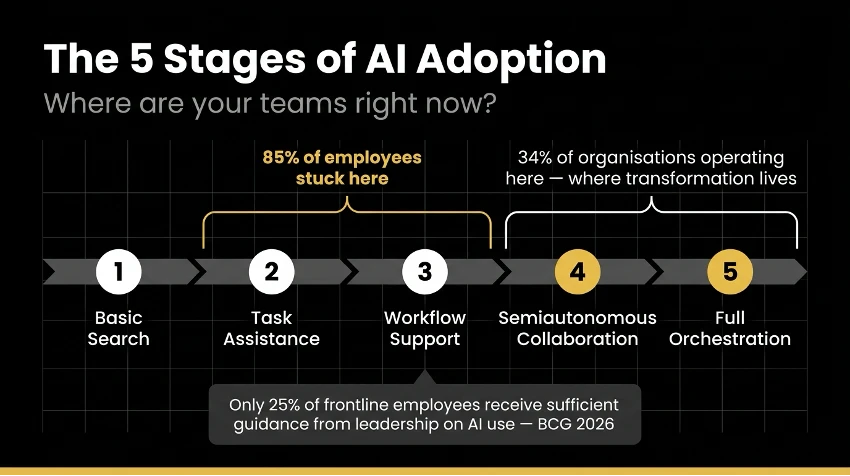
BCG mapped five stages of AI adoption, from basic usage (treating AI like a search engine) through to semiautonomous collaboration with AI agents running entire workflows.
The finding that should concern every business leader: more than 85% of employees remain stuck at stages two and three. They use AI for specific tasks — drafting, summarising, searching — without it ever becoming central to how they work.
Three barriers push people back to stage two every time:
Only 25% of frontline employees say they receive sufficient guidance from leadership on how to use AI effectively. Without a clear signal from above, people default to low-stakes AI use — where mistakes don’t matter. That keeps them permanently at the surface.
Less than 25% of AI learning happens during work hours. Employees are expected to upskill on personal time. Most don’t — or they develop shallow skills that never touch their most important work. Workflow redesign never happens.
This is the central failure. When the underlying workflow doesn’t change, using AI deeply creates friction rather than relief. People end up managing both the old process and the new tool. So they use AI at the edges, where it can’t change the outcome.
Deloitte’s 2026 enterprise AI research makes this tangible: 37% of companies are using AI at a surface level with no change to existing processes. Another third are redesigning some processes. Only 34% are truly reimagining the business. That 34% is where transformation lives.
The question isn’t whether your teams are using AI. It’s whether the way they work has changed.
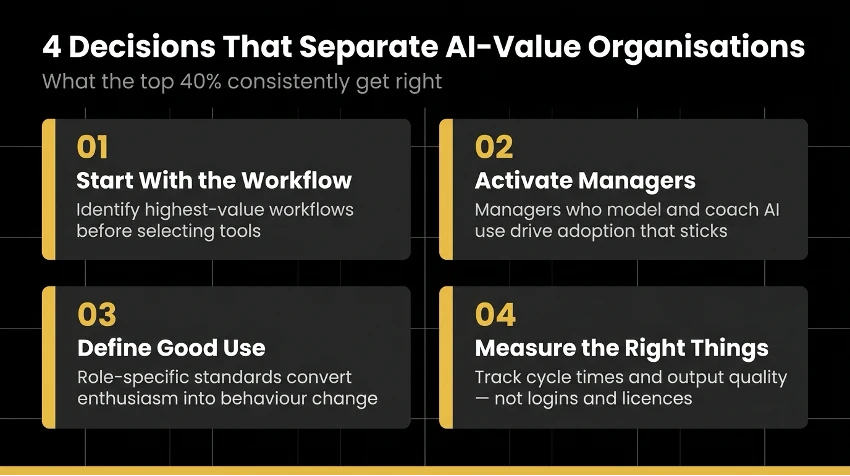
The organisations generating real AI adoption ROI for their business aren’t running more pilots or buying better tools. They’re making four decisions — consistently — that the other 60% skip.
The most common mistake in enterprise AI programmes is selecting tools before understanding which workflows they’re entering. Organisations getting results do the reverse: they identify the highest-value workflows first, map where AI can change the work (not just assist it), and then choose the tool that fits. Workflow redesign is the precondition — not the afterthought.
BCG’s research found that employee-centric organisations are seven times more likely to be AI-mature than peers. The mechanism is managers. Frontline managers who visibly use AI, set clear expectations for AI-assisted work, and coach the behaviour — not just encourage it — drive the adoption that sticks day to day.
Without manager activation, even well-designed programmes stall. Employees mirror their direct manager. If managers are absent or neutral, teams stay in stage two regardless of what leadership announces from above.
Vague encouragement to ‘use AI more’ produces vague results. Organisations driving real change define role-specific standards: what AI-assisted work looks like in this function, what outputs are expected, what review applies. This converts general enthusiasm into behavioural change — the kind that compounds over time.
Instead of tracking logins and licences, they track workflow cycle times, output quality, decision speed, and rework rates. These metrics reveal whether AI has changed how work happens. If they haven’t moved, adoption is surface-level — regardless of what the usage dashboard says.
→ If your teams are using AI but the work hasn’t changed
The World Economic Forum’s 2026 AI at Work report put it plainly: ‘Deploying AI without aligning it to workflows or without redesigning business processes with AI in mind ends up creating more work instead of less.’
More work instead of less. That is the result most AI programmes are producing right now — and it explains why usage rises while value doesn’t.
The organisations that break this pattern make a deliberate choice: they redesign the work before they embed the tool. They ask not ‘how do we add AI to this process?’ but ‘if we were designing this process today, knowing what AI can do, what would it look like?’
That is a harder question. It requires leadership alignment, structured capability building, and a change management approach that most rollouts skip entirely. But it is the question that separates the 40% from the 60%.
The 60% problem is not a technology problem. It is not a tool selection problem. It is a work design problem — and the organisations that recognise this early are the ones building competitive advantage right now.
Your teams don’t need more AI access. They need a structured path from AI curiosity to AI-embedded workflows. That path requires leadership alignment, workflow redesign, and capability building that sticks.
→ See how Humaine helps enterprises build that path
Why are most AI programmes generating no value even when usage is high?
Because usage and value are different measurements. High usage means people are logging in and trying tools. Value requires AI to be embedded in how core work actually gets done — which requires workflow redesign, not just access and encouragement.
What’s the most common reason AI adoption stalls at team level?
Absent manager activation. When managers don’t set clear expectations for what AI-assisted work looks like, teams default to using AI for low-stakes tasks where mistakes don’t matter — and never develop the deeper capability that changes outcomes.
How do you know if AI is actually producing business value?
Track workflow metrics — cycle times, output quality, rework rates, decision speed. If AI is genuinely embedded in how work happens, these move. If they haven’t changed, adoption is still superficial regardless of what the usage numbers show.
What should organisations do before deploying AI tools to teams?
Map the workflows first. Identify where AI can change the work — not just speed up individual steps — and redesign those workflows before rollout. This sequencing is the single most consistent differentiator between organisations generating value and those stuck in the 60%.