AI Confidence Is Collapsing While Usage Rises: What Enterprises Are Missing
Something unusual is happening across the global workforce.
AI usage is climbing. Tool access is expanding. Budget allocations are growing. By every metric organisations use to track deployment, AI is spreading.
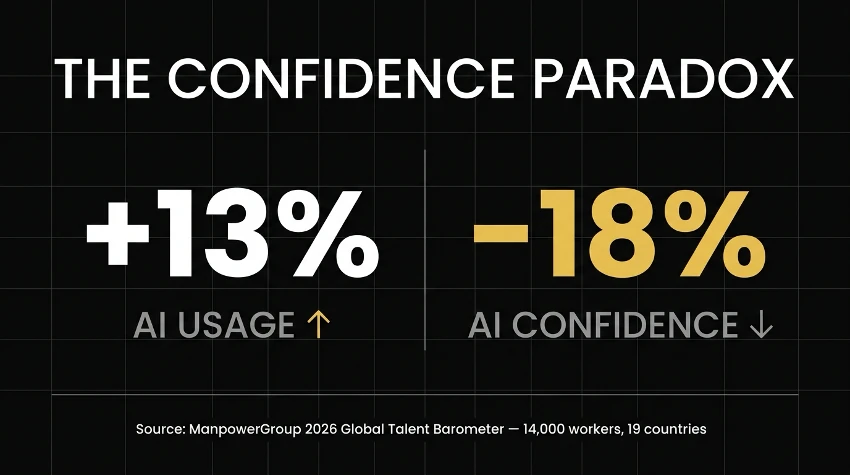
And yet, across 14,000 workers in 19 countries, ManpowerGroup’s 2026 Global Talent Barometer found that worker confidence in AI dropped 18% over the same period that usage rose 13%.
Usage up. Confidence down. That gap — quiet, uncomfortable, largely untracked — is the clearest signal that most enterprise AI programmes are building something fragile.
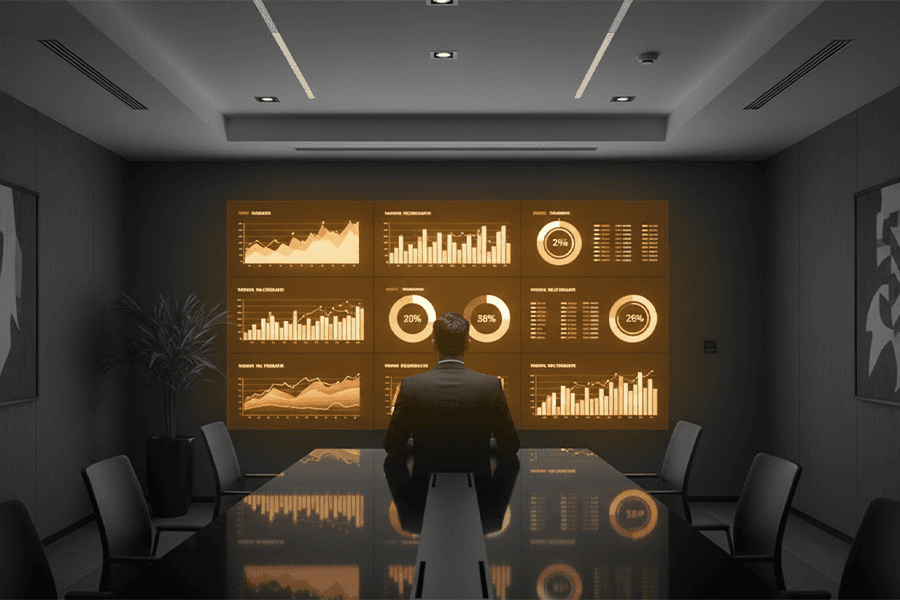
The standard enterprise AI dashboard tracks access. Licences purchased. Tools deployed. Logins per week. If those numbers are moving, leadership tends to interpret it as progress.
What those metrics miss entirely: whether the people using AI feel capable, clear, and confident doing it.
ManpowerGroup’s research reveals that confidence — the sense that you understand what AI is for, how to use it well, and how to judge when it helps versus hurts — is actively declining for the majority of workers. Even as they use the tools more.
This matters because confidence is the precondition for meaningful use. Workers who are uncertain about AI default to the safest possible behaviours: tools without structured support keep them away from anything that matters.
That pattern is not AI adoption. It is AI avoidance dressed up as AI use.
The instinct when workforce AI confidence is low is to provide more training. A new module. A lunchtime webinar. A prompt library shared on Slack.
That instinct misdiagnoses the problem.
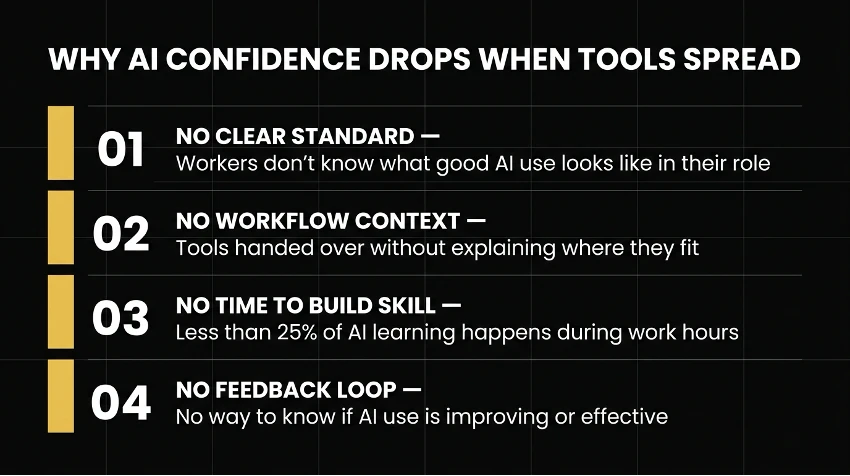
Confidence doesn’t drop because people lack awareness of AI. After two years of relentless AI coverage, awareness is nearly universal. Confidence drops for a different set of reasons — all of which are organisational, not individual.
When organisations deploy AI without defining what AI-assisted work looks like in each role, employees are left to improvise. That improvisation creates anxiety. Most people don’t know if they’re using AI correctly, deeply enough, or in ways that are acceptable to their manager. So they hedge — keeping usage visible but shallow.
Being given access to a tool is not the same as understanding where it fits in your workflow, what it’s replacing, and what it’s adding. Workers handed AI tools without that context feel like they’re using equipment they don’t fully understand. The result is chronic low-grade uncertainty that erodes confidence with every use.
ManpowerGroup’s data is consistent with BCG’s finding that less than 25% of AI learning happens during work hours. When upskilling is expected to happen in personal time, people develop structured time for capability development that never arrives.
In most AI rollouts, there is no mechanism for workers to know whether their AI use is good, improving, or effective. Without that loop, uncertainty compounds over time rather than resolving.
Giving teams tools without context, expectations, or structured support doesn’t accelerate AI adoption. It accelerates AI anxiety.
The business case for addressing this is straightforward.
Workers using AI with low confidence stay at the surface. They never bring AI into their highest-value work. They never experiment with applications that could change how the team operates. They use AI in ways that produce marginal gains — time saved on tasks that weren’t the bottleneck — while the workflows that actually drive output go untouched.
Over time, this produces a specific pattern of waste: high AI spend, low AI impact. Organisations invest in tools, train at scale, measure logins — and still find, two years later, that work hasn’t materially changed.
Fortune’s 2026 analysis of the confidence decline pointed to an additional risk: workers with low AI confidence are significantly more likely to disengage from AI programmes entirely. Not loudly — not by refusing or complaining — but by quietly treating AI as a box to tick rather than a capability to develop.
That disengagement is nearly invisible on a usage dashboard. It only shows up when you ask how the work has changed. And for most organisations, the honest answer is: not much.
The organisations building sustainable AI confidence across their teams are making a structural choice that others skip: they treat confidence as an outcome to design for, not a side effect to hope for.
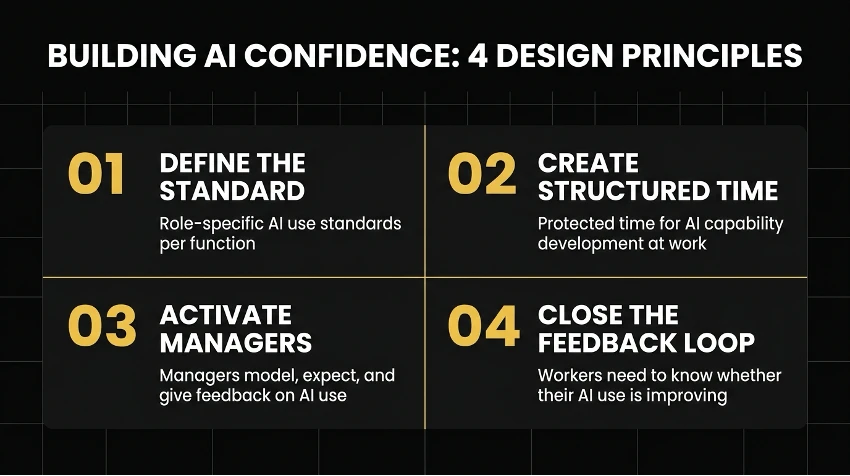
That means four things in practice:
Not generic guidance — role-specific standards. What does AI use look like in this function? What outputs are expected? What review applies? When workers know the standard, uncertainty drops and confidence grows in a direction that connects to actual performance.
Not a one-off module, but a repeatable practice: time to experiment with feedback, and experiment within real workflows rather than training environments that don’t connect to actual work. Structured time signals that AI capability is a professional priority, not a personal project.
The fastest path to workforce AI confidence runs through the direct manager. Managers who visibly use AI, who set clear expectations, who acknowledge their own learning curve, and who give feedback on AI use — these managers build confident teams. Organisations without this layer produce confident dashboards and uncertain workers.
Workers need to know whether their AI use is improving. That doesn’t require complex measurement — it requires regular, practical feedback on what good looks like in their specific work context. Without it, uncertainty fills the gap.
Because confidence isn’t built by access — it’s built by context, capability, and clear expectations. When tools are deployed without structured support, workers use AI in ways that don’t resolve their uncertainty. Over time, uncertainty compounds.
It looks like AI use that stays shallow and safe. Workers use AI for visible, low-stakes tasks and avoid applying it to core work or high-stakes decisions. The usage dashboard looks healthy; the work itself doesn’t change.
Significantly. Teams with managers who actively model AI use, set clear expectations, and give feedback on AI-assisted work are measurably more confident. Without manager activation, even well-designed programmes produce confident tools and uncertain teams.
Start by defining what good AI use looks like in each role. Create structured time for capability development during work hours. Activate managers as the confidence layer. Close the feedback loop so workers can gauge their own progress. These are organisational design decisions — not training interventions.
The confidence gap is not a communication problem. You cannot close it with a newsletter or a CEO message about the importance of AI.
It is a structural problem. Organisations gave their teams tools without context, expectations, or a supported path to capability. The predictable result is a workforce that is technically using AI and practically uncertain about almost everything that makes AI valuable.
Closing the gap requires the same thing that drives every dimension of real AI adoption: structured design. Define the standards. Create the conditions. Activate the managers. Close the loop.
The 18% confidence decline is not a warning about the future. It is a description of what most enterprise AI programmes are producing right now.
→ Talk to Humaine about building AI confidence alongside AI capability